
Pressure reducing valve installation
A pressure reducing valve, also called a pressure regulator or PRV, sits on the main water line and keeps the pressure in the house safe and steady. When it fails, pressure climbs: pipes bang, toilets run, and fixtures and water heaters wear out early. We test the pressure, replace the valve and set it properly.
Signs the pressure is too high
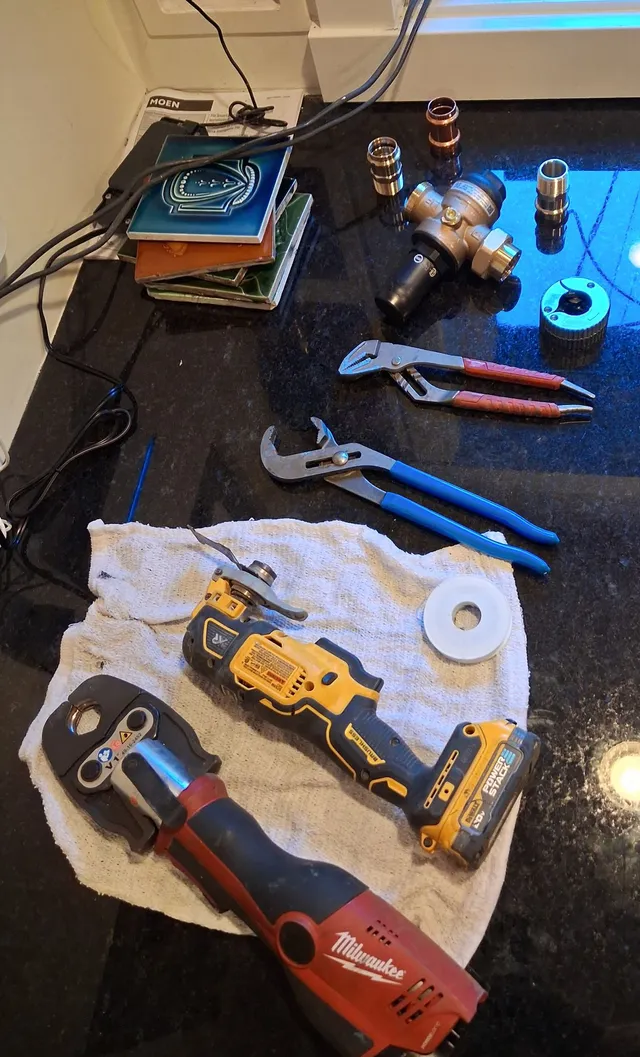
The photo is a new pressure-reducing valve laid out with its press fittings and tools, before we cut it into the main line.
What we are called for
- Banging pipesWater hammer when a tap, dishwasher or washing machine shuts off.
- Running toilets and dripping tapsFill valves and cartridges wear out faster under high pressure.
- A dripping relief valveThe water heater’s relief valve weeping: high pressure, or no expansion tank.
- Pressure that swingsStrong one minute and weak the next, the usual sign of a failing regulator.
- Failed supply linesBraided connectors and old fittings giving out before they should.
- A valve nobody has checkedAn old regulator that has never been tested or adjusted.
How we replace a pressure reducing valve
First we put a gauge on a hose bib or the water heater drain and read the pressure. The plumbing code calls for a reducing valve when the incoming pressure is over 80 psi, and most homes are comfortable well below that.
Then the water is shut off at the main, the old valve comes out and the new one goes in, with press fittings or unions so the next service is easy. We set the outlet pressure, check it at a fixture and look over every joint before we leave.
A reducing valve makes the plumbing a closed system, so hot water expanding in the tank has nowhere to go. If the water heater has no expansion tank, we fit one; without it, the relief valve keeps dripping.
Why Queen Plumbing
Same-day for most calls, Monday to Friday. Free written estimate. Licensed, bonded and insured, and we test the pressure before and after so you can see the difference.
Licensed, local, and on the record
- Licensed Bonded and insured in Washington
- Founder 15+ yrs in the plumbing trade
- Always Free estimates
- Available Same-day service
- Our promise 100% satisfaction guaranteed
Pressure reducing valve questions
Do I have a pressure reducing valve?
Look on the main water line just after the shut-off, usually in the basement, crawl space or garage: a bell-shaped brass valve with an adjusting screw on top. If you cannot find one, we can check during the estimate.
What should my water pressure be?
Most homes are comfortable between 50 and 70 psi. Above 80 psi the plumbing code calls for a reducing valve, because fixtures, hoses and appliances are not meant to sit at that pressure all day.
Can a pressure reducing valve be repaired?
Some can be rebuilt with a kit. With an older valve, replacing it is often the better value. We will tell you which makes sense for yours.
Why is my water heater relief valve dripping?
Often because the pressure is too high, or because there is no expansion tank to take up the hot water as it expands. We check both.
Pipes banging or pressure too high?
Call for a pressure test and a free estimate. Same-day for most calls, Monday to Friday.
Serving Seattle, Shoreline, Bellevue and Mercer Island.